

Are Rooftop Tents Worth It for Off-Road Travel?
Quick Summary
Rooftop tents are worth it for off-road travel if you move camp often, camp on rough or sloped ground, and want to sleep off the ground. They set up in minutes and level themselves on uneven sites, but they add roof load, reduce fuel economy, and cost more than ground tents. Check your vehicle's roof load limit before buying.
- Most models deploy in minutes, suiting overnight stops and brief campsites.
- Sleeping above ground keeps you away from dust, moisture and ground animals.
- Always check your vehicle's roof load rating, not just the rack's rating.
- Wind resistance can affect steering and reduce fuel economy at highway speeds.
- A ground tent suits base camps, severe wind and easy child or pet access.
Table of Contents
- Why Rooftop Tents Suit Off-Road Travel
- Rooftop Tent Pros and Cons for Australian Touring
- Rooftop Tent vs Ground Tent: Which Suits Your Trips
- Rooftop Tent Weight and Vehicle Roof Load Explained
- Handling, Fuel Use and Wind Effects on the Road
- Keeping Your Rooftop Tent in Good Condition
- Choosing a Rooftop Tent for Your Next Trip
- Frequently Asked Questions
Are Rooftop Tents Worth It for Off-Road Travel?
Last Updated: October 28, 2026
Rooftop tents have become one of the most common upgrades for Australian 4x4 owners heading off the bitumen. Is a rooftop tent actually worth the money for off-road touring, or is it just another accessory that looks good in photos? The honest answer is that it depends on how you travel, what your vehicle can carry, and how much time you spend setting up camp. Balancing the added weight of a tent with the right off-road vehicle upgrades ensures your suspension can handle the extra load while maintaining stability on uneven terrain.
Why Rooftop Tents Suit Off-Road Travel
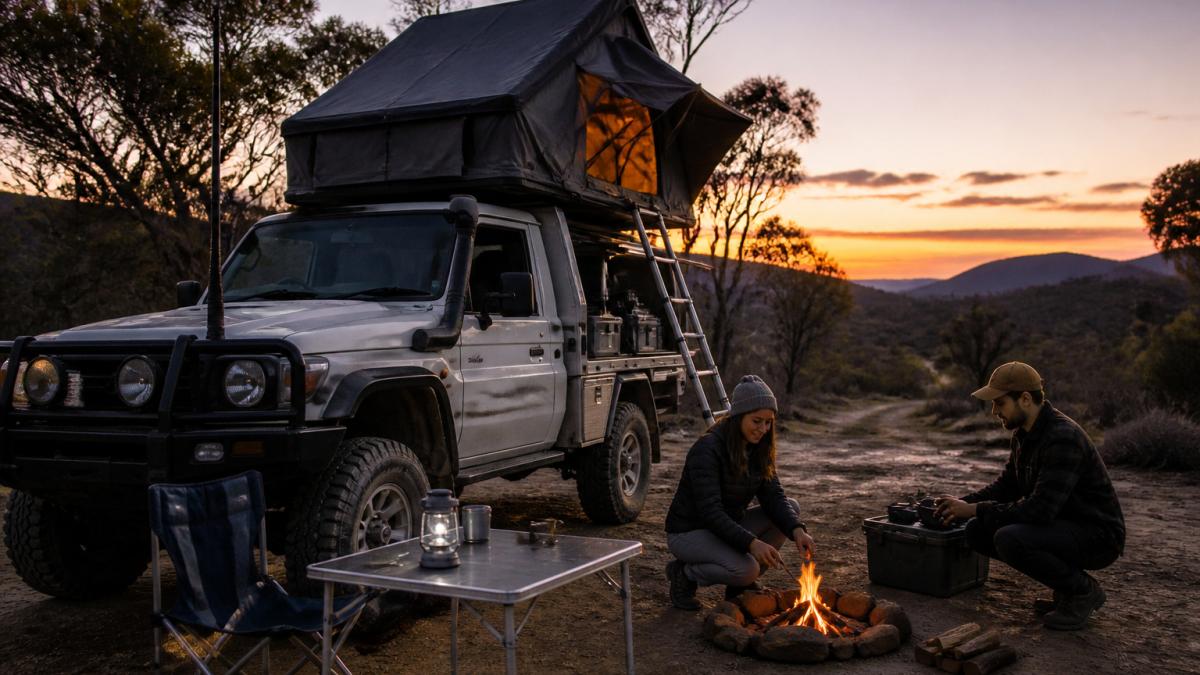
A rooftop tent is a shelter mounted on your vehicle's roof rack that folds out into a sleeping platform. Its main appeal for off-road travel is that you sleep off the ground, away from uneven terrain, rocks, and whatever else lives in the bush.
The biggest advantage is flexibility. You can stop at a track junction, a river crossing, or a rough clearing without hunting for flat ground.
Rooftop Tent Pros and Cons for Australian Touring
Rooftop tents are not the right choice for every traveller. Before you commit, it helps to weigh what they do well against where they fall short.
Where Rooftop Tents Win
- Quick setup and pack-down. Most models deploy in minutes, which suits overnight stops and campsites you only use briefly.
- Elevated sleeping. You sleep above dust, moisture, and ground animals, and you avoid the uneven ground that makes ground-tent camping uncomfortable.
- Keeps your gear in the vehicle. Your camp kit lives in the car rather than in a pile beside the tent.
- Good weather protection on modern models. Hard-shell designs and quality fabrics offer solid waterproofing for typical touring conditions.
Where They Fall Short
- Added weight up top. The tent and rack add load that your vehicle must carry safely, which affects handling.
- Wind and fuel economy. A roof-mounted tent creates wind resistance, which can affect steering and reduce fuel economy, particularly at highway speeds.
- Access to your roof. You need a clear, safe way to get in and out, and you'll need to lower or fold the tent before driving.
- Upfront cost. A rooftop tent is a significant purchase, so the economics only work if you'll use it regularly.
Rooftop Tent vs Ground Tent: Which Suits Your Trips
The choice between a rooftop tent and a ground tent comes down to how often you camp, where you camp, and who's coming with you. A ground tent is cheaper, lighter, and keeps the weight off your vehicle, but it takes longer to set up and sleeps you on the ground.
Most comparisons stop there. The more useful question for off-road travel is where each option actually performs better once you are off the bitumen, because campsite selection, not the tent itself, often decides which one wins on a given night.
Campsite selection: the factor most guides skip
A rooftop tent frees you from needing flat, clear ground. You can park on a slight slope, on rocky ground, or in a tight clearing and still sleep level, because the vehicle does the levelling. That is a real advantage on tight tracks where flat campsites are scarce.
A ground tent, by contrast, needs a clear, reasonably level patch free of rocks, roots, and spinifex. On heavily used or rough terrain, finding that patch can take longer than pitching the tent itself.
But the rooftop tent has its own campsite constraints:
- You must be able to park where you sleep. If the track is too narrow, too steep, or too soft to park safely overnight, the rooftop tent is no help.
- Wind exposure. A vehicle parked on an exposed ridge catches more wind than a tent tucked into scrub. In severe weather, a ground tent in a sheltered spot can be the safer choice.
- Vehicle positioning. You need room to deploy the ladder safely and to walk around the vehicle. On a side slope, think about which side the tent opens and where the ladder lands.
- Evacuation access. If you need to leave quickly, weather, wildlife, a medical issue, climbing down a ladder in the dark is slower than stepping out of a ground tent.
When a ground tent is genuinely better
- You are base-camping in one spot for several nights and can leave the vehicle set up.
- You are travelling with young children or pets who need easy, repeated access in and out.
- You are camping in severe wind and can shelter the tent in scrub or behind terrain.
- You want to leave camp set up and drive away without packing the tent down.
- Your vehicle is already near its roof-load limit with other gear.
When the rooftop tent earns its place
- You are moving daily and want a fast setup and pack-down.
- You are camping on rough, uneven, or rocky ground where a ground tent is awkward.
- You want to sleep off the ground away from moisture, dust, and ground animals.
- You are touring solo or as a couple and value the simplicity of one integrated setup.
If you mostly camp at established sites with flat ground, a ground tent may be enough. If you're regularly pulling into remote spots where the ground is rough and time is limited, the rooftop tent starts to earn its place. The honest answer is that many serious tourers carry both, a rooftop tent for moving nights and a small ground tent for base camps or as a backup.
The right choice depends on how and where you camp, so here is how the two options compare once you are off the bitumen.
| Factor | Rooftop tent | Ground tent |
|---|---|---|
| Setup speed | Deploys in minutes | Takes longer to pitch |
| Ground needed | Vehicle levels the sleep, works on rough or sloped ground | Needs clear, reasonably level patch |
| Vehicle load | Adds roof weight | No added roof weight |
| Best for | Moving daily, rough terrain | Base camps, severe wind, easy child or pet access |
| Evacuation | Slower, ladder descent | Quick step out |
Rooftop Tent Weight and Vehicle Roof Load Explained
This is the area most buyers overlook, and it's where safety matters most. Your vehicle has a maximum roof load limit set by the manufacturer, and that limit covers the roof rack, the tent, the mattress, bedding, and anything else you carry up top. Exceeding it affects braking, cornering, and stability, especially on rough tracks, and the effect compounds the higher the weight sits above the roof line.
San Hima Kalbarri Gen 2 Lite Roof Top Tent Hardshell With Ladder →
Static versus dynamic roof load
Roof-load figures come in two flavours.
- Static load is what the roof and rack can support when the vehicle is parked. This is the figure that matters when the tent is deployed and people are inside it, and it is typically much higher than the dynamic figure.
- Dynamic load is what the roof and rack can carry while the vehicle is moving, over corrugations, through dips, and under braking. This is the figure that governs whether your tent is safe to travel with, and it is the one you must check against the combined weight of rack, tent, and bedding.
A rack rated for a 90kg load is quoting a working figure, but you still need to confirm your vehicle's own roof limit, because the lower of the two governs. If your vehicle's roof is rated to 80kg and the rack to 90kg, 80kg is your ceiling.
Centre of gravity and why it matters off-road
A rooftop tent raises a significant mass above the vehicle's centre of gravity. On a sealed road that mostly shows up as slightly heavier steering and more lean in corners. Off-road it matters more: side slopes, off-camber tracks, and steep descents all become less forgiving when there is extra weight up high. A common pattern among experienced tourers is to keep heavy recovery gear and water low in the vehicle and reserve the roof for the tent and light items only.
Practical checks before you buy
- Find your vehicle's roof load rating in the owner's manual, not the rack's rating, the vehicle's.
- Weigh the tent, the rack, and your usual bedding together. Add a margin for wet canvas.
- Confirm the rack's dynamic rating exceeds that combined figure.
- Check the tent's mounting footprint matches your rack's cross-bar spacing.
- Re-check torque on mounting hardware after the first rough track and periodically thereafter.
Handling, Fuel Use and Wind Effects on the Road
Once a tent is on the roof, your vehicle drives differently. Expect some extra wind noise and a slight change in steering feel at highway speeds, and allow for reduced fuel economy. Take corners and crosswinds more gently, and avoid stacking extra gear on the roof beyond what your setup can safely carry.
Plan your fuel stops around the extra consumption, and fold the tent down when you're not camping to reduce drag. Keeping your speed moderate is one of the simplest ways to offset the wind resistance.
Keeping Your Rooftop Tent in Good Condition
A rooftop tent is exposed to sun, dust, and moisture for most of its life, so routine care pays off. Dry the fabric fully before packing it away to prevent mildew, check seams and zips regularly, and keep the mattress aired out. If you camp in cold weather, a diesel heater fuel tank can help you keep the tent warm. Inspect the mounting hardware after rough tracks, since vibration can loosen fittings over time.
Choosing a Rooftop Tent for Your Next Trip
Start with your vehicle and your travel style. Check the roof load rating first, then decide between a hard-shell and soft-shell design based on how much weight and setup speed matter to you. Hard-shell tents tend to deploy quickly and handle weather well, while soft-shell options can be lighter and more affordable.
Our San Hima hard-shell range is a good place to start. The Kalbarri Gen 2 Lite Roof Top Tent Hardshell With Ladder ($2,499.00) is built to be slim and lightweight, with a 138mm packed height that suits garage or undercover parking.
Whichever you choose, match it to your vehicle, your typical trips, and how much you're willing to spend. A rooftop tent is worth it when it fits how you travel, and it's worth passing on when it doesn't.
Frequently Asked Questions
What's the point of a rooftop tent?
A rooftop tent lifts your sleeping area off the ground and mounts on your vehicle's roof rack, so you carry your bed with you. The trade-offs include added roof weight and a higher centre of gravity, so check your vehicle's roof load before buying.
Are rooftop tents suitable for rough tracks?
Suitability depends on the tent and your vehicle setup. Check your vehicle's roof-load rating and the tent's specifications before buying.
Do rooftop tents affect a 4x4's fuel use and handling?
A rooftop tent adds weight high on the vehicle. Check your vehicle's roof-load rating and consider how the added load fits your setup.
How do you choose a rooftop tent for a 4x4?
Start with your vehicle's roof load rating and match the tent's weight to that limit. Consider how many people will sleep in it and whether you want a hard-shell design. The San Hima Kalbarri Gen 2 Lite Roof Top Tent Hardshell With Ladder weighs 74kg and has a 138mm packed height. Browse our rooftop tent range to compare options and specifications.


